

Director: Brad Abrahams (2021)
Length: 12:06
Link to watch the film: https://www.shortoftheweek.com/2021/07/22/do-you-see-what-i-see/
Keywords: Conspiracy; extremist; politics; society; transcendence; USA; psychological
As extremists and conspiracy theories create a façade of fear and pull back the curtains of what deep states are like, filmmaker Brad Abrahams explores a once talented and prevalent Hollywood artist’s fall into the rabbit hole: David Dees’ descent into madness. Abrahams manages to capture the empathetic version of Dees while illuminating the true version of Dees and his uncharismatic beliefs.
Throughout the film, specific ideas that the director places within the viewer can be seen to try and un-box Dees. We can see that Dees lives an alternative life compared to most common Americans – but why is his story so interesting?
It could be hard to try and understand Dees when many of his personal philosophies go against many people. Yet, it is easier to witness when we can see that his vision is distorted. Only demonstrated through connections and references made by Abrahams does the film imply that Dees could suffer from a form of schizophrenia or similar psychoses. He presents these ideas when Dees talks about his Cadmium poisoning and demonstrates that mental health disorders (and/or symptoms) can be exasperated by Cadmium.
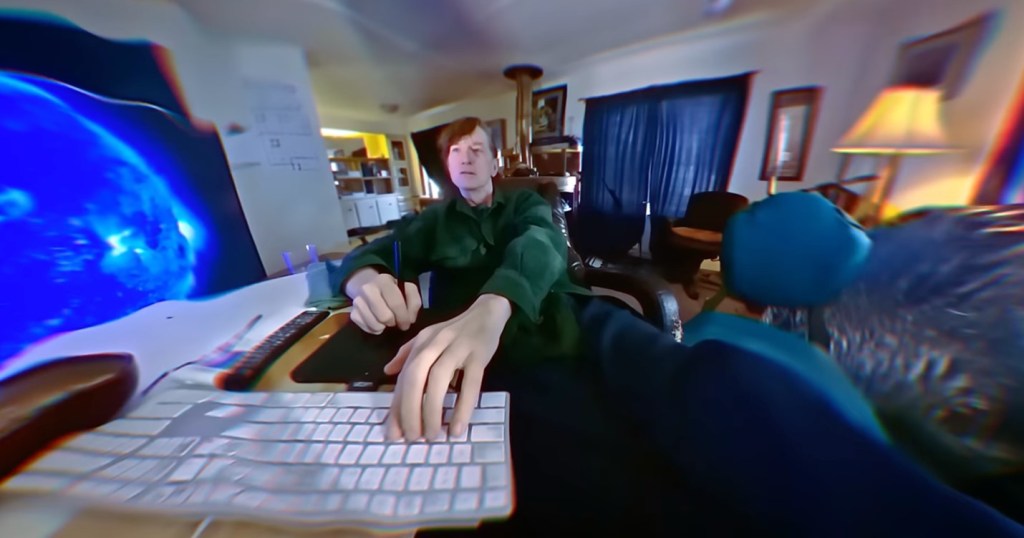
This type of distorted view is clearly and intriguingly demonstrated through special effects added when the camera is focused as if we are looking through his vision (a 360-degree camera). Through the added speed of time, focused view, and coloured effects we can see that his vision of reality feels like a hazy dream.
This type of film imagery is also only demonstrated when Dees describes some of his higher spiritual experiences or when the director is trying to help gain insight into his perspective. We can see that the distortion is meant to help the viewer once again gain a better understanding of Dees and empathize with his reality.
As Abrahams brings us deeper and deeper into the mind of Dees demonstrating some disturbing thoughts, he further contrasts this with images of Dees at home on his land and enjoying his life. This evokes a sense of peace for the watcher. He creates the contrast to demonstrate that amidst all of Dees’ ideologies and strange beliefs, it helps to show that he is a real person and shares similarities of living a life like all of us. A dichotomy is presented contrasting the madness of his mind and loud thoughts in his extremist beliefs with the quiet of the land and all his gentle surroundings, enabling the viewer to allow some empathy for Dees.
However, as Abrahams frames Dees as a person rather than a figurehead of conspiracists, we once again see the extremist ideologies to which the director makes a personal connection, this is done through examples of drawings and posters Dess has created. The only other time that the director shows himself is when Dees is discussing his use of Jewish symbols and Zionism. The director states that he is Jewish to personify himself for Dees to attempt to understand more deeply the root of his thinking and see Dees’ reaction. However, throughout the film Abrahams can be heard asking Dees interview questions, providing the viewer with some truth and bringing them back to reality with some of the heavy topics being discussed.
“If anybody gets upset, hey man, it’s my opinion. I can’t have an opinion? What now you’re upset…umm okay…I’m terribly insensitive in that way. So I stand by the art.”
–Dees (with a smiling face)
In many of the choices Abrahams makes, he wants to demonstrate all aspects of Dees (work and personal life). Looking at the life and decisions that Dees has made, we can begin to understand his mental state and depiction of himself to the world. The film purposely seems relativity unopinionated from Abrahams’ point of view. Flipping between clips of peace, then chaos, peace, then chaos, and finally attaining true peace as he passed later after the film was posted. However, for the viewers watching it is understandable how his beliefs became so valued within his life and in a sense kept him grounded. It’s understandable how hard it can be to decentralize his personal philosophies when Dees’ whole life is lived essentially alone with only the information from the internet to keep him company and provide access to his skewed viewpoint on the world and news.
References:
Abrahams, B. (2021). Do you see what I see? [Video]. Short of the week. Retrieved from https://www.shortoftheweek.com/2021/07/22/do-you-see-what-i-see/
Davis, A. (n.d.) [Figure 1]. Brad Abrahams: Direction + Conception. Retrieved from http://bradabrahams.net/dyswis
 Film reviews for anthropology passionates