
Directed by: Carol Nguyen (2019)
Film Length: 16 minutes
No Crying at the Dinner Table is now available on Short of the Week (link below).
https://www.shortoftheweek.com/2020/12/23/no-crying-dinner-table/
Documentary; Family; Loss; Grief; Communication
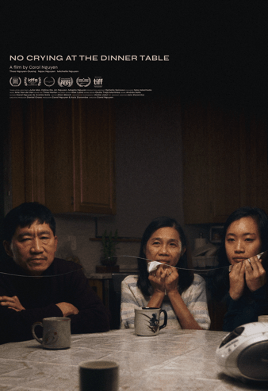
Regardless of your culture, customs, or family dynamics, an experience many people can resonate with is having something in your family that you simply do not talk about. Whether this is because it’s too painful, or because you’ve been raised to bottle-up uncomfortable emotions to avoid conflict, having difficult conversations about traumatic things is not easy to do. This is why No Crying at the Dinner Table is such a powerful film, that is bound to have you reaching for handkerchiefs.
In this award winning 2019 documentary, Vietnamese-Canadian film student Carol Nguyen interviews her own family about their secrets, conflict, and guilt, revealing the complexities of human emotions and relationships in a beautifully poignant way. Nguyen’s mother starts the interviews off with a captivating line that instantly sets up the raw vulnerability that occurs in this film. “I only kissed my mother once”, she says, while masterful shots show her cooking her family a handmade meal. This parallel shows the complexities of a family’s love in a subtle but moving way. The Nguyen family then goes on to sit at their dinner table together and listen to the recorded interviews, which results in a stunningly intimate moment.
Despite No Crying at the Dinner Table being fairly short, running at 16 minutes, it’s able to leave a lasting impression on its audience for many reasons. Even though this documentary focuses on the intricacies of a family its audience does not know, it’s impossible not to sympathize with them because it’s relatability resonates with so many. Seeing trauma confronted in this way is emotional and personal, but it’s filmed with such respect that it doesn’t leave it feeling exploitive or like you’re intruding on the family’s private life. This intimacy is also successful because of the filmmaker’s connection to the subjects. When watching a documentary, the audience may expect a certain distance from the crew behind the camera and the subjects in front of it to encourage full transparency and a lack of bias. However, this film proves how a lack of bias is impossible, and that fact can certainly be used in the director’s favor. Nguyen’s choice to interview her own family is what makes the film work so well, and it leaves the audience with an assurance that the family is opening up for the right reasons.
This is why No Crying at the Dinner Table can also be something of a comfort to watch, because like Nguyen says in an interview on her website Carol Nguyen Films (linked below), “this is definitely not something that everyone should or could do with their family.” However, it may be able to give its viewers the reassurance they need that change can happen, if only you aren’t afraid to speak up.

Still, before No Crying at the Dinner Table’s release, and even in the documentary itself, Nguyen’s parents expressed some confusion about the purpose of the film. They didn’t understand why anybody would want to hear their story, viewing it as “normal” and stating that they “weren’t celebrities”. This is a story that feels very common within many different families, so naturally anybody in their position might feel the same way. However, as the years since the documentary’s release has proven, sometimes the most familiar stories are the ones that leave the biggest mark.
Since the documentary’s premiere at Toronto International Film Festival (TIFF) in 2019, it has gone on to be named in TIFF’s top ten list for short films, be nominated for best short documentary at the 8th Canadian Screen Awards in 2020, and win the SXSW Short Film Grand Jury Award for Documentary Short. This prestigious win makes No Crying at the Dinner Table a contender for a 2021 Oscar nomination, one in which it most certainly deserves.
 Film reviews for anthropology passionates