
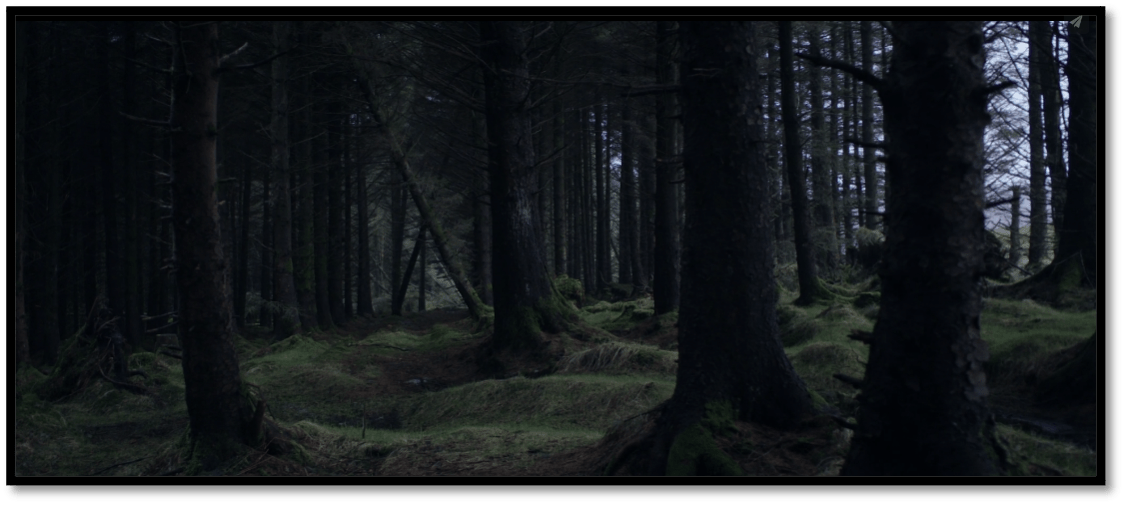
“In the Space Between Ages”
Directed by Travis Lee Ratcliff
2020
9 Minutes
Keywords: Art; Sculpture; Education; Drawing; Painting; Autonomy; Nature
Link to the Film: https://www.shortoftheweek.com/2018/11/13/in-the-space-between-ages/
Every individual has their own path in life, and many peoples do not conform to societal expectations. Artist Travis Lee Ratcliff’s story in the short film “In the space between ages” is a tale that displays how complicated a person’s life can be. As a person who produces art in several different medias, such as sculpting, painting, and drawing, Ratcliff shares how art became such an important aspect of his life. However, in order to fully understand Ratcliff’s journey through art, one must be able to have a extended understanding of how art has formed human civilization. It is not unknown that examples of art have been recorded in almost every prominent civilization that human beings have ever created. However, the term art is much more complex and comes in many more forms then may be genuinely considered. For instance, it can be argued that early humans’ symbolism during the paleolithic age suggests not only evidence for human behaviour but also the first instances where humans have incorporated art. Therefore, since modern humans’ early presence, the use of art has been a dependent way of self-expression.
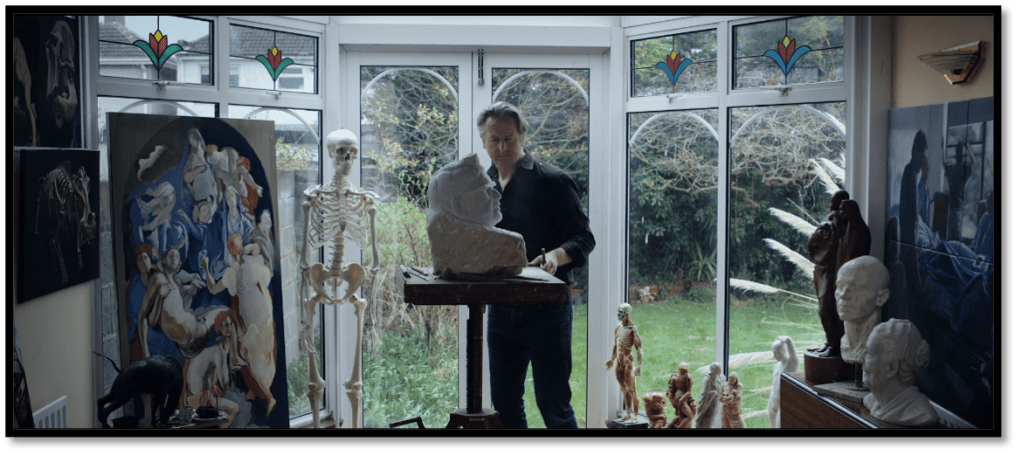
Despite this, in modern-day western society pursuing a career in visual arts has become stigmatized to be an occupation that is not respected the same way as working-class jobs. In addition, this stigma is further justified through education systems, especially in elementary and secondary schooling, where students are pushed to pursue courses in subjects that are not the visual arts. Ratcliff makes it known quite early in this film that as a dyslexic person, he could not succeed in many academic subjects and was punished as a consequence of his own learning disabilities. His teachers’ use of punishment, he says, was the primary way in which art, specifically drawing, became a coping mechanism for him. Within this use of art as coping, Ratcliff was able to find a way through his learning disability and learn the language of art, which he truly understood.
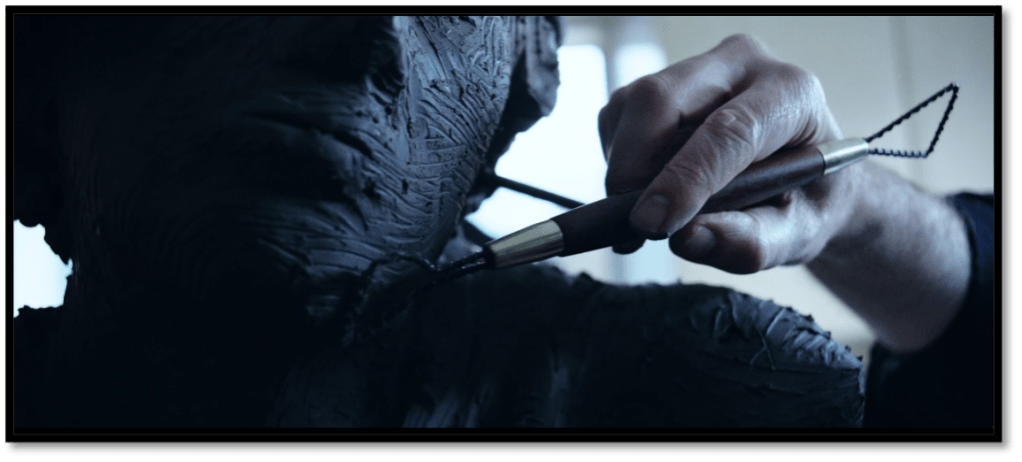
Seeing that this film delves into Ratcliff’s journey towards his use of sculpting and other art media, it becomes noticeable that visualization of the process of sculpting becomes an essential aspect of the film itself. Moreover, when discussing the notion of sculpting, Ratcliff states, “I love the humility of the clay, that you can transform a piece of mud into a magnificent mystical image.” Throughout the film, Ratcliff focuses not only on specific types of sculpted objects but also on the act of sculpting some of these objects. For instance, there are several scenes where the audience observes Ratcliff either carving or shaping his work at different stages. This inclusion of a variation in his art processing and the methods he uses to form the sculptures emphasize how crucial texture is in this film. It can also be suggested that although the narration of this film is important, the visual representation of texture is equally essential in the frame that Ratcliff is exploring. It is also imperative to note that quite similar to art, Ratcliff’s use of texture comes in several different forms. For instance, one can observe texture primarily in the art he is creating, but Ratcliff also focuses on texture in landscape, buildings, and even his own hands. What also becomes notable is Ratcliff’s consistent use of close-ups on images to infer a more in-depth meaning onto the object’s interpretation. This focus is likely to do with his fixation on connecting art and its history together as a unified body, suggesting that despite the fact that any of the images shown seem to be random on their own when they are sequenced together, they produce a unified story.
Although this film only covers the basics of how complex art is viewed in society, Ratcliff is able to provide the viewer with an explanation of this concept through his use of selected images. In addition, one statement that conveys the message of this film is when Racliff states, “Freedom really exists within the mastering of what you have been given.” What is being made known through this statement is that even if someone does not fit within societal expectations, they can still thrive if they pursue the talents that they already have in a positive way.
 Film reviews for anthropology passionates