

Unless the Water is Safer Than the Land
Arjang Omrani and Mehrdad Razi
Oct.23, 2020
30:38
Refugees; minors; Germany; Europe; refugee-crisis; arranged-marriage; police; border-crossing; boat; undocumented; underage-refugees;
https://boap.uib.no/index.php/jaf/article/view/2865/3046
This film seeks to tell the stories of several underage refugees arriving in Cologne, Germany. Every story is told only through subtitles, providing a powerful monologue that is accompanied by what is at first seemingly unrelated footage. The viewer is forced to pay closer attention to aspects like word choice, rather than relying on tone or pace, and as there is no consistent plot to the footage either the viewer is left trying to figure out how the footage shown relates to the story being told, capturing the attention of the audience.
The film begins with the story of a young woman who fled her country due to an arranged marriage that her parents supported. The opening footage is shaky and frantic, like that taken from a body cam as someone hides behind cars. In this way, the directors provide a sense of how the girl may have been feeling, without ever revealing her voice or the way in which her tone changes. The shift from a sort of desperate movement in the footage to one of stillness in the footage of grey clouds from an airplane seems to reflect her need to flee her marriage and therefore her country as quickly as possible, only to have to stop and essentially stand still, waiting for someone to pass judgement on whether she can stay once she enters Germany.
The second story told is that of a boy who had to prove that he was still a minor. Shots of a calm German street harshly contrast with his story of being forcibly examined by doctors and then sent back to his home country. He speaks of being stripped and photographed by the police, and a shaky clip of a boy undressing is shown alongside it. When he speaks of the shame he felt we see more frantic and shaky images of this man undressing, illustrating the increasing desperation and embarrassment that the subtitles tell us of. In this way, the footage shown adds to the story that the subtitles are telling, creating an emotional dimension that the subtitles cannot convey in the same way.
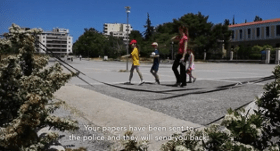
This process repeats once more, with a refugee talking about his family boarding a boat to come to Germany. As he speaks about his journey, the subtitles are juxtaposed with footage of carefree students sitting on a blow up boat, laughing and pretending to row. The footage is extremely at odds with the subtitles, lending a sense of unease and disbelief, a tactic seemingly used by the filmmakers to make the viewer uncomfortable and therefore more likely to critically examine why they feel this way. The next scene contributes to this uneasiness; as the filmmaker walks along a mountain ridge surrounded by beautiful scenery, a wire fence suddenly appears; it is out of place, unnatural, and its existence interrupts what we were expecting to see.
The final scene is that of an airplane taking off. There is a sense of powerlessness in the monologue delivered by the subtitles, and a sense of distrust in government officials and case workers. There is a great sadness in the narrators story when speaking of leaving one’s home country as the plane leaves, as well as a sense of crushing disappointment at the rejection of refugees by countries like Germany. There is also anger, in contrast with the relatively peaceful footage of clouds that we see, at the unjustness of the world and our refugee system.

The footage and the narration style in this film make the stories of the refugees stand out. We have seen many films, interviews, and stories from refugees throughout the ongoing refugee crisis. However, this film takes these stories and presents them in a new way. The viewer is left feeling slightly disoriented, unsure of what is going on, and yet completely focused on what each refugee is sharing. The often confusing, frantic, or seemingly unrelated footage is accompanied by stories that add a personal dimension to refugees. While many people are not refugees, almost everyone can relate to feeling disappointed in their parents’ decisions, to feeling embarrassed, to feeling scared, or to feeling anger and distrust, and the use of camera movement, lighting changes, and scenery in the footage accentuates those feelings and creates a sense of empathy within the viewer.
 Film reviews for anthropology passionates