
Director: Andrea Bordoli
Year of Production: 2020
Length: 18min
Keywords: Nature; Machines; Farming; Sensory; Relationships;
Link to watch the film: https://boap.uib.no/index.php/jaf/article/view/3040
Jessi Rowse-Mercier
Deep within the Swiss Alps lies the Robiei Power Plant. Home to not only a massive hydroelectric system but also a cheese farm consisting of a few dozen goats, cows and one very happy border collie.
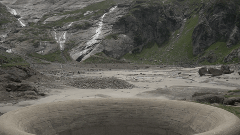
Andrea Bordoli beautifully encapsulates two very different worlds which are separated only by the earth between them. The film opens with beautiful long scenic shots of the mountains only to moments later be sliced with machines and technology filling the entire frame. This truly sends the message to the viewer that these ideas which surround us every day are in fact incredibly opposite. We as a species are so used to being within concrete walls and streets that most of us have to drive somewhere to even enter nature. Yet, we are so dependant on both machines and our natural resources to survive.
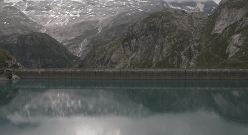
The film is filled with long still shots allowing for the visuals to speak for themselves. The 18 minutes are full of sensory exploration. Almost every shot has a different sound which fill the space completely. The cow and goat bells are the closest thing one will hear to a sound track until the closing minute in which one of the workers plays on a mouth harp. The only sounds which come from the “beneath” within the plant are the whirring of machines, fans and some slight chatter between the workers. Picking up on all the different sounds took a second watch as at first I was unsure of what the film was telling me. As time went on though, I realized the film nor Bordoli was trying to tell me anything, rather gave me the opportunity of an experience.
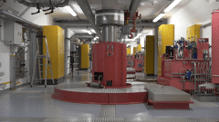
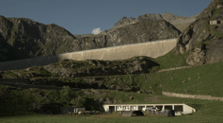
The bridge between these two alien worlds is the workers. Us, the humans who are the ones making the films in the first place. The only thing you see which connects them are the farmers and the plant employees. Without them – or us as a species – there would be no plant, no cheese, probably not even the animals.
With an almost entire lack of dialogue one may think this film could be boring or confusing, however it is neither of those things. Each different shot brings new thoughts or understandings of what you’re actually seeing. I watched this film a few times over and each time I picked up something I had missed in my prior viewings. Upon my first watch, I was unsure of what the plants’ function was or what the purpose of the animals were. However, as the film went on, each frame like a new piece being added to the puzzle, you can fill in the details. This allowed for quite an inquisitive and unique viewing experience.
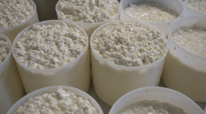
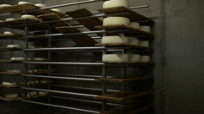
It is amazing what one can accomplish with just a camera and microphone. Bordoli creates a small pocket of art in which we can reflect and think. We as humans influence so much around us, virtually everything, and we create these monolithic imprints on the world which will stand for thousands of years once abandoned. Ironically the things in which we put all of our love, talents, energy and time are either non physical such as music, poems or love, or they are objects in which are almost always doomed to fade with time, at least much quicker than a concrete power plant will. And yet, we carry on with doing those exact things day in and day out such as making cheese and movies. I guess, that is what truly makes us human.
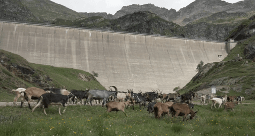
These two worlds may on paper and when compared seem so different from one another, but they rely on each other. The farmers rely on the energy from the plant to power their machines and tools so that they may milk the animals to then collect and sell to the townsfolk who buy it and consume it so that they may go and work at the plant. If we are to think about our creations as humans as an extension of nature then we may begin to understand and accept ourselves better and hopefully then we can create a better place for all of us.
Bordoli’s film perfectly encapsulates the juxtaposition of being a human today and the 18 minute ride is beautiful.

Link to watch the film: https://boap.uib.no/index.php/jaf/article/view/3040
 Film reviews for anthropology passionates