
Title of documentary: A CAMP IS A WALL IN A FOREST
Director(s): Anna Knappe & Amir Jan
Year of production: 2019
Length (duration): 18 minutes, 30 seconds
Keywords: (refugees, migration, reception centre, Afghanistan, asylum seekers, mohajers, social suffering, ethnographic film, anthropological film, identity, isolation, belonging).
Link to watch the film: https://doi.org/10.15845/jaf.v3i02.2697
Reviewed byErika Jraij
Film Review: “A CAMP IS A WALL IN A FOREST”
We have all experienced moments of uncertainty. But, how many of our lives are actually defined by that uncertainty?

Image from A Camp is a Wall in a Forest
The 2019 film, “A Camp is a Wall in a Forest”, shares the experiences of Afghani refugees, who are living in an isolated camp for asylum seekers. Despite seeking asylum to improve their circumstances, the camp acts like a wall, blocking them from securing their own futures and livelihoods. Instead, the camp traps them in a life filled with countless restrictions and a never-ending cycle of suffering from their past. Directed by Anna Knappe and Amir Jan, the nearly 19-minute film sheds light on the difficult and painful circumstances of refugees.
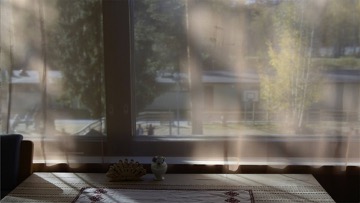
Knappe, A. (2018). [Two objects and a cloth on top of a table that is standing against a window with a view of the outside camp and trees]. Retrieved from http://annaknappe.com/a-camp-is-a-wall-in-a-forest-2018/
A Limited View with No Sense of Belonging
The anthropological film is filled with beautiful imagery of the dark-green forest that surrounds the camp, the camp unit itself, and the people living within it. Light is manipulated and images are slightly blurred to frame the contents and message of the film perfectly. As viewers, we do not get to see the camp in a different way than those living inside of it. This portrays how truly isolated the camp is from the rest of the world and the heavily restricted life of a refugee. The camera allows us to view some of the living areas within the camp, such as the sleeping and dining areas. One thing I took note of was the few personal belongings in these rooms, which I felt further emphasized this restricted lifestyle.
I often find myself taking for granted the personal touch that I am privileged to give to my environment. Bedrooms are often adorned with decorations, framed photographs, different types of furniture, and many other personal belongings. This allows me to create a space that is not only my own but provides me with a sense of belonging. For refugees at the camp, they are not granted that same sense of belonging or feeling of ownership. Instead, they are left with a constant reminder of their temporary life that is plagued with memories from their past sufferings. Eventually, these past sufferings fuse with their present struggles, such as threat of deportation. This is further suggested by one of the refugees, who says that deportation is inevitable and refugees are often always preparing to start a new life all over again.
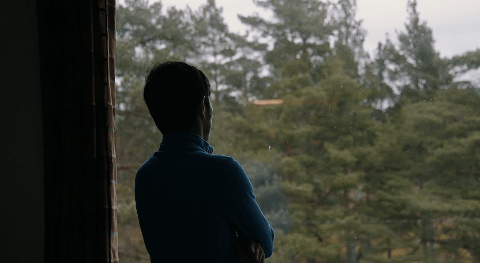
Image from A Camp is a Wall in a Forest
A Dehumanizing Lack of Independence
The first thought that comes to mind when moving to a new place is leading a more independent life with a limitless future. However, that is not an equally guaranteed reality for everyone. For refugees, moving to a new country often means having less freedom and a future filled with uncertainty. In the film, one of the refugees tells a story of not being allowed to open a window to ventilate his room, in which he is told by a staff member that his rights are limited to shelter and food. I recall during my childhood and adolescence needing to ask my parents for permission to do something, but I could never imagine asking them for permission now that I am adult. The idea of having to ask for permission as an adult feels inherently dehumanizing and humiliating. In fact, it seems to have other negative impacts as one of the refugees mentions it often hinders their self-independence and diminishes their acquired skills.
Another problem I noticed was how financially reliant the refugees are on the camp. A man details his painful experiences of receiving a monthly allowance from the camp. He experiences a sense of humiliation and shame for having to “get money to live”. This also facilitates the loss of independence and contributes to the dehumanization of already vulnerable people. I often take the privilege of financial independence for granted. There is a sense of pride in being capable of financially supporting yourself and others. So, I find myself relating to the pain and feeling of failure when needing additional financial support, regardless of how necessary it is for survival.
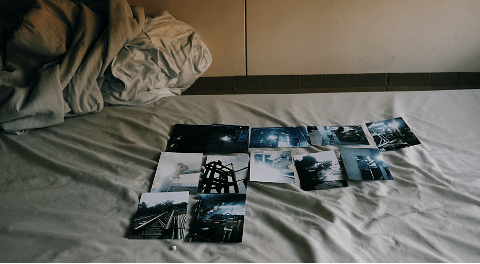
Image from A Camp is a Wall in a Forest
Expectations and Perceptions
Furthermore, there is the expectation to be grateful set upon refugees. I have personally observed this in similar cases regarding people of color receiving governmental or private assistance that is reminiscent to the ‘savior complex”. However, the pressure is not placed on the one doing the ‘saving’ but rather the person receiving it. Another refugee often questions others’ intentions on helping him because he does not want to viewed as a ‘charity case’. He mentions that when people learn that he is a refugee, they begin to treat him like a wounded animal, which he finds condescending and degrading. It is easy to brush him off as being ungrateful when you are not thinking about the whole situation in a holistic manner. As citizens, we do not experience the extent of social suffering that refugees do. Refugees not only have to deal with the memories of their past sufferings but are also forced to endure the ridicule and negative perceptions that comes with their refugee status. According to people of the camp, many outsiders’ often view them as ‘normal’ people until they begin speaking with their different accent or language. This film is not the first showcasing of the blatant racism and discrimination faced by refugees. For instance, Donald Trump was elected as the President of the United States just prior to the film’s release. Subsequently, this led to the Trump administration tightening the legal immigration laws, resulting in the separation of many families and forced many to live in crowded and often abusive detention centers.

Image from A Camp is a Wall in a Forest
“Refugee”
Furthermore, the process of applying for asylum is also a degrading act on its own as expressed by one of the camp members. He mentions that many people often fail to acknowledge the human experience behind being a refugee and often forget that people do not seek to be a refugee. People often take for granted the privilege of being born into a country that not only accepts you as a citizen but is also a safe and secure place to live. Many of us often forget that refugees are real human beings typically fleeing poor circumstances, or even from war and famine. They are people who have no choice but to abandon their homes, families, and jobs to gain more opportunities or sometimes safety. Furthermore, he mentions that the term ‘refugee’ is actually inherently dehumanizing because “you have to beg for the right to exist”. Often, many refugees are stateless, they are typically forced to relinquish their own citizenship, and then are stuck to endure a long application process filled with a sense of uncertainty.
“A Camp is a Wall in a Forest” illustrates the amount of uncertainty experienced by refugees. The camp is a place they wait for approved refugee status or deportation. Prior to that knowledge, the camp acts like a wall meant to stop these real human beings from achieving their hopes and dreams, only allowing them to eat and sleep, and reinforces their social suffering.
To watch Anna Knappe’s and Amir Jan’s incredibly eye-opening film on refugees, visit the Journal of Anthropological films’ site, or click here: https://doi.org/10.15845/jaf.v3i02.2697.
 Film reviews for anthropology passionates