

General Information
Duration: 1h 46min
Directed by: James Lebrecht, Nicole Newnham
Executive Directors: Michelle Obama, Barack Obama
Keywords: disabilities; activism; 1970s; discrimination; revolution; neurotypical; youth; sex
*Watch Crip Camp Here*
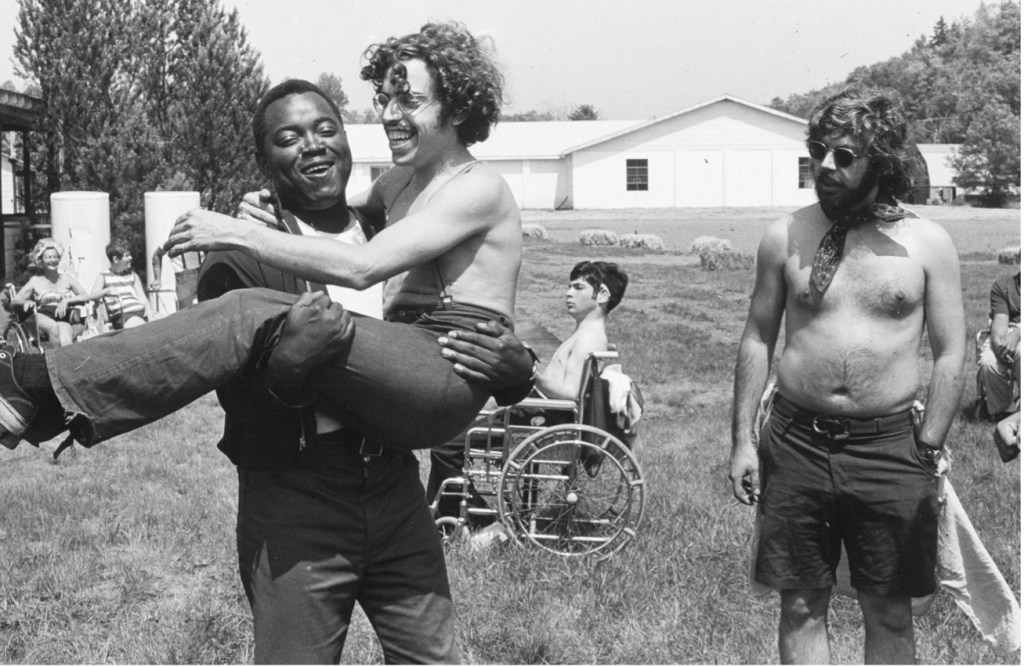
“[Camp Jened] allowed us to recognize that the status quo was not what it needed to be.”
–Judy Heuman, activist
Crip Camp (March 2020) documents through oral storytelling and striking visuals the tale of camp Jened, a summer camp for disabled children run by hippies, and the subsequent disabled rights movement which snowballed as a result.
Crip Camp is shot in three space-time continuums. Firstly, there is footage from camp Jened in the 70’s shot by a collective called the “People’s Video Theater”. These visual and verbal memoirs from campers depict Jened as a paradise for the disabled run by hippies, an alternative Woodstock, if you will. Jened was a glimpse for campers into what they were truly capable of and how many people had shared experiences. Campers felt included, valid, and capable. This footage consists mostly of interviews with the campers where they openly discuss topics such as how they are treated in normal life, the lack of privacy that they are extended at home, the strain of overprotective parents and camp crushes.
Secondly, there is footage from the 70’s and 80’s of the disability rights movements, in which Jened alumni Judy Heuman is most often featured. Judy was both a camper and counsellor who later went on to sue the state of NY after being denied a license to teach on the basis of discrimination. This propelled her headfirst into the world of activism where she headed the cause for disability rights in NYC in the 70’s and later led the 504 sit-ins of 1977.
Third, these two timelines are woven together with present day footage in which several Jened alumni are interviewed. The interviewees recount tales from Camp Jened and how it planted the seed for the fervent activism which ensued in the decades following. One topic that is continuously addressed throughout the film is the denial or non-recognition of disabled people as sexual beings. One feisty interviewee named Denise who has cerebral palsy describes how in her youth a doctor removed a perfectly healthy appendix because it did not occur to him that she might be sexually active and suffering from gonorrhea instead of appendicitis. Denise cheekily details several sexual experiences and explains how she went on to do a master’s degree in human sexuality despite the stigma and confusion she faced from others. Denise and her husband also address the fact that there is a hierarchy within the disabled. Those with cerebral palsy were treated as less than those with polio because they are physically further from the status quo. This results in discrimination within the disabled community itself.
Crip Camp recounts the untold history and evolution of the disabled rights movement in the US from the 70’s-present through interviews with activists themselves. The film holds a detailed account of the fight for Section 504 of the 1973 Rehabilitation Act. 504 stated that any federally funded building or service could no longer discriminate against disabled people. Meaning that school campuses, public transportation, streets, and anything else receiving federal funding, all needed to be rendered accessible for disabled bodies. The eventual passing of this law was thanks to public pressure caused by the 28 day sit in of the HEW building in San Francisco. James Lebrecht (who sporadically narrates and co-produced the film) notes that these sit ins were not typical because people went without personal aids, changing their catheters and many other complexities. The black panthers supported the protesters by bringing hot meals and a local LGBT salon owner came to help provide basic hygiene services to those who were unable to access them alone. The film is brutally realistic about the fact that laws are not passed to the full extent that the protestors were demanding, and that as civilian vigilance wains so does the impact and integrity of previous victories.
It is heart-warming to hear how these different movements banded together to support one of the largest minorities; the disabled. Because of this, many have described Crip Camp as a “feel-good” film, but I think this is antithetical to its core intention. The message of the film is a critique on our society which has been constructed with only neurotypicals and physically able bodies in mind. One of the camp counsellors explains that the problem is not people with disabilities, it is with everyone else who are either oblivious to these problems or choose to ignore them.
Crip Camp is a delightfully enlightening film. It emphasizes the importance of empowering youth and the necessity of coupling an imagined better reality with determination and follow through. Lebrecht and Newnham did a wonderful job of balancing serious social and political issues with lightheartedness and hope. This film will cause you to think deeply without leaving the bitter aftertaste of overwhelming helplessness in your mouth.
 Film reviews for anthropology passionates